



CAGR explained: what compound annual growth rate means for your portfolio
CAGR—compound annual growth rate—is the rate at which an investment would have grown each year if it had grown at a perfectly steady pace. It converts the total gain or loss of any investment into an annualised figure, making performance comparable across different time periods and assets.
What CAGR measures
Compound Annual Growth Rate is the standard metric for expressing long-run investment performance as a single, comparable annual rate. It became ubiquitous in investment reporting partly because it solves the arithmetic mean return’s systematic overstatement of true compound growth—a distortion documented formally by Markowitz (1959) in Portfolio Selection: Efficient Diversification of Investments, John Wiley & Sons, who noted that the arithmetic mean return always exceeds the geometric mean when returns are variable.
CAGR answers a specific question: if this investment had compounded at a constant annual rate, what would that rate have been? The result is a single percentage that summarises multi-year performance in terms that are intuitive and directly comparable across different investments and time horizons.
The metric takes a price series as its input—requiring a starting price, a final price, and the number of periods elapsed—and produces an annualised return figure. Because it accounts for the effect of compounding, CAGR differs from simple average annual return: an investment that falls 50% in year one and rises 100% in year two has a two-year cumulative return of zero but a mean annual return of 25%. CAGR correctly returns 0%.
Higher CAGR is generally preferable, all else being equal. But like all return metrics, it should be read alongside risk measures—two portfolios can show identical CAGR while one achieved it through steady gains and the other through severe volatility. Return and risk together tell the complete story.
The formula
CAGR = (Pn / P0)T/n − 1
Where:
- Pn = final price
- P0 = initial price
- T = number of periods per year (252 for daily data, 12 for monthly)
- n = total number of periods in the series
The exponent T/n converts the total return into an annual rate. For a daily price series covering two years, T is 252 and n is approximately 504, so the exponent is 0.5—equivalent to taking the square root of the total price ratio. For monthly data over five years, T is 12 and n is 60, giving an exponent of 0.2.
How to interpret CAGR
CAGR is best understood as the equivalent steady annual return that would have produced the same total outcome. An investment that grew from USD 10,000 to USD 16,105 over five years has a CAGR of approximately 10%, because 10,000 × 1.10⁵ ≈ 16,105.
What counts as a good CAGR depends on asset class, risk level, and the period being evaluated. A diversified equity index has historically delivered annualised returns of roughly 7–10% in real terms over long periods. A multi-asset portfolio targeting lower volatility would typically show a lower CAGR alongside materially smaller drawdowns—the trade-off that makes it appropriate for investors who cannot or do not wish to absorb the full volatility of equities.
A common misinterpretation is to read CAGR as a guaranteed or typical annual return. CAGR describes the past outcome; individual years within the period may have varied enormously. An investment with a 12% CAGR over ten years may have had years of +40% and years of −30%. CAGR averages all of this into a single smooth figure. For understanding the dispersion around that figure, volatility and maximum drawdown are the appropriate complements.
Rolling CAGR
The scalar CAGR summarises the full measurement period as a single figure. Rolling CAGR computes the same metric over a sliding window of fixed length—for example, calculating the CAGR for every trailing five-year period throughout a longer history. Each point on the resulting chart answers the question: what was the compound annual growth rate for the five years ending on this date?
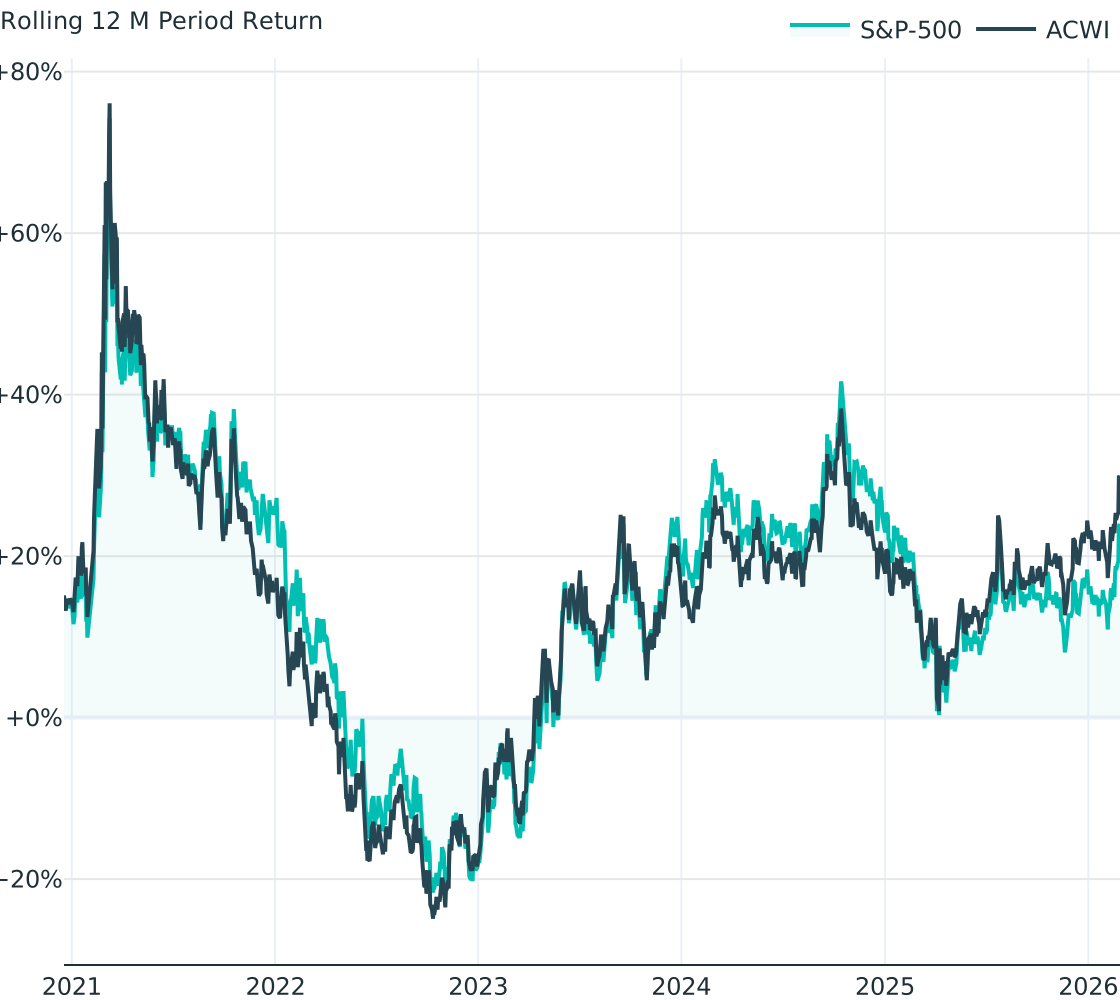
Rolling CAGR: S&P-500 vs. ACWI
This view is valuable for several reasons. It shows how CAGR varies across different market environments, revealing periods of strong sustained growth and periods of persistent weakness. It also provides a realistic picture of the range of outcomes an investor might have experienced depending on when they entered the investment—a practical concern that the full-period CAGR cannot address.
The window length is configurable. Shorter windows produce more reactive series that capture recent conditions clearly; longer windows—five or ten years—are more appropriate for assessing sustained compounding and filtering out shorter-term noise. Rolling CAGR is available in the pfolio app.
Limitations
CAGR hides intra-period volatility and drawdowns entirely. A portfolio with a 10% CAGR achieved through a smooth upward path and one that reached the same endpoint via a 40% peak-to-trough decline both show identical CAGR. The investor experience of holding the second portfolio—and the behavioural challenge of staying invested through severe losses—was fundamentally different. Assessing CAGR without reference to drawdown and volatility gives an incomplete picture of portfolio quality.
CAGR is also sensitive to the start and end dates chosen. An investment that performed strongly until a sharp decline at the measurement endpoint will show a considerably lower CAGR than one measured to a peak. This endpoint sensitivity is a known limitation of all price-based return metrics and should be considered when comparing results across different periods or sources.
Finally, CAGR is a backward-looking metric. It describes what happened over a specific historical period and provides no information about what is likely to happen in the future. Past compounding rates—even over long periods—do not predict future performance.
CAGR in pfolio
In pfolio, CAGR is calculated on time series price data. By default this uses the close price; switching to adjusted close—which accounts for dividends and splits—can be configured via advanced settings. The choice of price series affects the result, particularly for dividend-paying assets over long periods. See time series data and metric types for a full explanation.
CAGR is displayed alongside rolling CAGR in the pfolio app. For a full description of how pfolio calculates this and all other metrics, see the metrics we use.
Related metrics
Disclaimer

Get started now


