



Mean return explained: how to measure average investment performance
Mean return is the arithmetic average of an investment’s periodic returns, scaled to an annual figure. It answers a straightforward question: over a given period, what did this investment return on average per year? As a starting point for evaluating performance, it is one of the most widely used metrics in portfolio analysis—and one of the most frequently misunderstood.
What mean return measures
The arithmetic mean return and its relationship to compound growth was analysed formally by Markowitz (1959) in Portfolio Selection: Efficient Diversification of Investments, John Wiley & Sons, who showed that the arithmetic mean always exceeds the geometric mean when returns are variable—and that this gap grows with volatility. The implication is that mean return systematically overstates what an investor actually compounds over time, which is why CAGR is the more appropriate measure for long-horizon wealth accumulation.
Mean return is calculated from the series of periodic returns—daily, weekly, or monthly depending on the price data available. Each return is the percentage change from one period to the next. The arithmetic mean of these periodic returns, when annualised, gives the mean return figure.
The metric is directional and has no bounded range. A positive mean return means the investment has grown on average; a negative figure means it has lost value on average. In pfolio, a higher mean return is preferable, but mean return should never be assessed in isolation—it must always be read alongside a risk measure such as volatility or maximum drawdown. A high mean return achieved through extreme volatility tells a very different story from the same return achieved through steady growth.
The formula
r̅ = (T/n) × Σ(rᵢ)
Where:
- r̅ = annualised mean return
- T = number of periods per year (252 for daily data, 12 for monthly)
- n = total number of periods in the return series
- rᵢ = return for period i
The formula multiplies the average periodic return by the number of periods per year to produce an annualised figure. For a daily return series of 500 observations (approximately two years of trading days), T is 252 and n is 500, so the multiplier is 252/500 = 0.504—less than one, because each day’s return represents a fraction of a year. The mean of those 500 returns, multiplied by 0.504, gives the annualised figure.
How to interpret mean return
Mean return answers the most basic performance question: did this investment grow or shrink on average, and by how much? A mean return of 8% per year means the investment returned approximately 8% annually across the measurement period. A mean return of −2% means it lost ground on average.
The key limitation is that mean return does not compound. Consider an investment that falls 50% in year one and rises 100% in year two. Its arithmetic mean return is 25% (−50% + 100% / 2). But its actual compound growth is zero—the investor ends the two years exactly where they started. For measuring actual wealth accumulation over time, CAGR is more appropriate. Mean return is most useful as a short-horizon reference or as a component in other calculations such as the Sharpe ratio.
A common misinterpretation is to assume mean return is representative of the typical annual return. Because of the arithmetic-to-geometric divergence illustrated above, mean return tends to overstate what an investor actually accumulates when returns are volatile. The more volatile the return series, the greater the gap. This is not a flaw in the metric—it is simply what it measures. Mean return is the expected value of a single period’s return; CAGR is the compound growth rate of the full period.
Rolling mean return
The scalar mean return figure summarises the entire measurement period as a single number. Rolling mean return computes the same metric over a sliding window—for example, calculating the annualised mean return for every trailing 12-month period throughout a longer history. Each point on the chart answers the question: what was the annualised mean return over the past 12 months ending on this date?
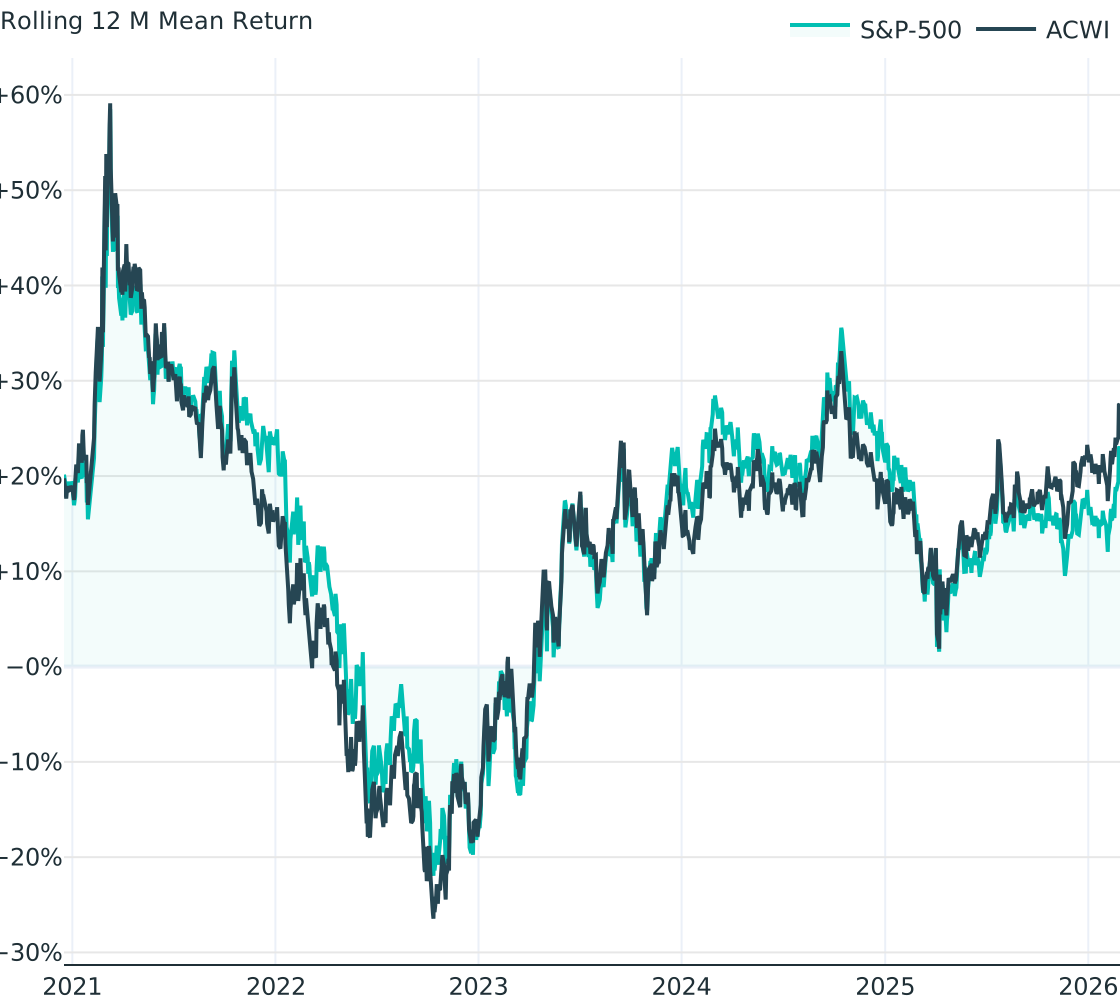
Rolling 12 M mean return: S&P-500 vs. ACWI
This view is useful for understanding how returns have varied across different market environments. A rolling mean return chart that shows consistently positive values through a full market cycle provides stronger evidence of performance than one that shows high average returns driven by a short window of exceptional performance.
Rolling mean return is available in pfolio Insights and the pfolio app. The window length is configurable.
Limitations
Mean return does not account for the path of returns, only their average. Two portfolios with identical mean returns but very different volatility profiles present very different risks and very different investor experiences. Mean return is incomplete without a risk measure.
Because mean return is arithmetic, it overstates long-run compound growth when returns are volatile. This divergence grows with both the level of volatility and the length of the measurement period. For long-horizon performance assessment, CAGR is almost always the more appropriate figure.
Mean return is also sensitive to extreme observations. A single year of very high or very low returns can materially change the mean, particularly in shorter time series. This sensitivity can make mean return a misleading summary statistic for investments with fat-tailed return distributions.
Mean return in pfolio
In pfolio, mean return is calculated from the return series derived from the price data. Whether those returns are computed from the close price or the adjusted close price can be configured via advanced settings—a distinction that matters for dividend-paying assets.
Mean return is displayed alongside rolling mean return in pfolio Insights, as well as the pfolio app. For a full description of how pfolio calculates this and all other metrics, see the metrics we use.
Related metrics
Disclaimer

Get started now


