



Return skewness: why asymmetric risk matters in portfolio management
Skewness measures the asymmetry of an investment's return distribution. While volatility captures how widely returns are dispersed, skewness captures whether that dispersion is balanced or whether it tilts toward large positive or large negative outcomes. In risk management, the direction of that tilt matters considerably more than the raw magnitude of dispersion.
What skewness measures
The observation that financial return distributions are asymmetric was formalised by Benoît Mandelbrot (1963) in The Variation of Certain Speculative Prices, Journal of Business, which demonstrated that commodity and equity returns exhibit heavier tails and greater asymmetry than a normal distribution predicts. Subsequent research by Fama (1965) in The Behavior of Stock-Market Prices, Journal of Business, confirmed these findings for equity returns, establishing skewness and kurtosis as material properties of financial distributions that standard models must account for.
A perfectly symmetric return distribution has a skewness of zero—gains and losses of equal magnitude occur with equal frequency, and the distribution is shaped the same on both sides of the mean. Most financial return distributions are not symmetric. Skewness quantifies the direction and degree of this asymmetry.
Positive skewness means the distribution has a longer or thicker tail on the right: extreme positive returns occur more frequently than extreme negative ones. Negative skewness means the opposite—the left tail is heavier, meaning large losses are more common than large gains of similar magnitude. For investors, the sign of skewness matters as much as its magnitude: a negatively skewed distribution is one where the typical experience is good, but rare severe losses are possible. A positively skewed distribution has frequent small losses but occasional large gains.
In pfolio, negative skewness is treated as adverse: it implies a left tail that an investor is exposed to, often without it being visible in summary statistics such as mean return or volatility.
The formula
Skew = [n/((n−1)(n−2))] × Σ((ri − r̄)/σ)³
Where:
- n = number of return observations
- ri = individual return observation
- r̄ = mean return
- σ = standard deviation of returns
The formula computes a normalised third moment of the return distribution. Each return's deviation from the mean is divided by the standard deviation (normalising for scale) and then cubed (preserving the sign of the deviation). The cube is critical: a negative deviation produces a negative cubed value; a positive deviation produces a positive cubed value. The sign of the average determines the sign of the skewness. Because deviations are cubed rather than squared, the measure is disproportionately sensitive to observations far from the mean—exactly the extreme outcomes that skewness is designed to capture.
How to interpret skewness
A skewness of zero indicates a symmetric distribution. Positive values indicate a right-skewed distribution; negative values indicate a left-skewed distribution. For financial returns, the magnitude of skewness typically falls between −2 and +2, though values outside this range are possible, particularly for short return histories or highly concentrated strategies.
As a practical example: a market-neutral strategy that sells short-term options might show a mean return of +0.5% per month and a volatility of 3%, but a skewness of −1.8. On most months, the strategy performs steadily. Occasionally, it experiences a month of −18% or worse when the options it has sold expire deeply in the money. The negative skewness captures this: the distribution has a heavy left tail that the mean and standard deviation do not reveal. An investor relying only on Sharpe ratio would not see it.
Skewness should be read alongside kurtosis, which measures the thickness of the distribution's tails. Negative skewness combined with high kurtosis describes a return profile with both a heavy downside tail and more frequent extreme outcomes than a normal distribution would predict—a meaningful combination for risk assessment.
Rolling skewness
The scalar skewness figure summarises the asymmetry of the full return history. Rolling skewness computes the same metric over a sliding window, showing how the distribution's asymmetry has evolved through time.
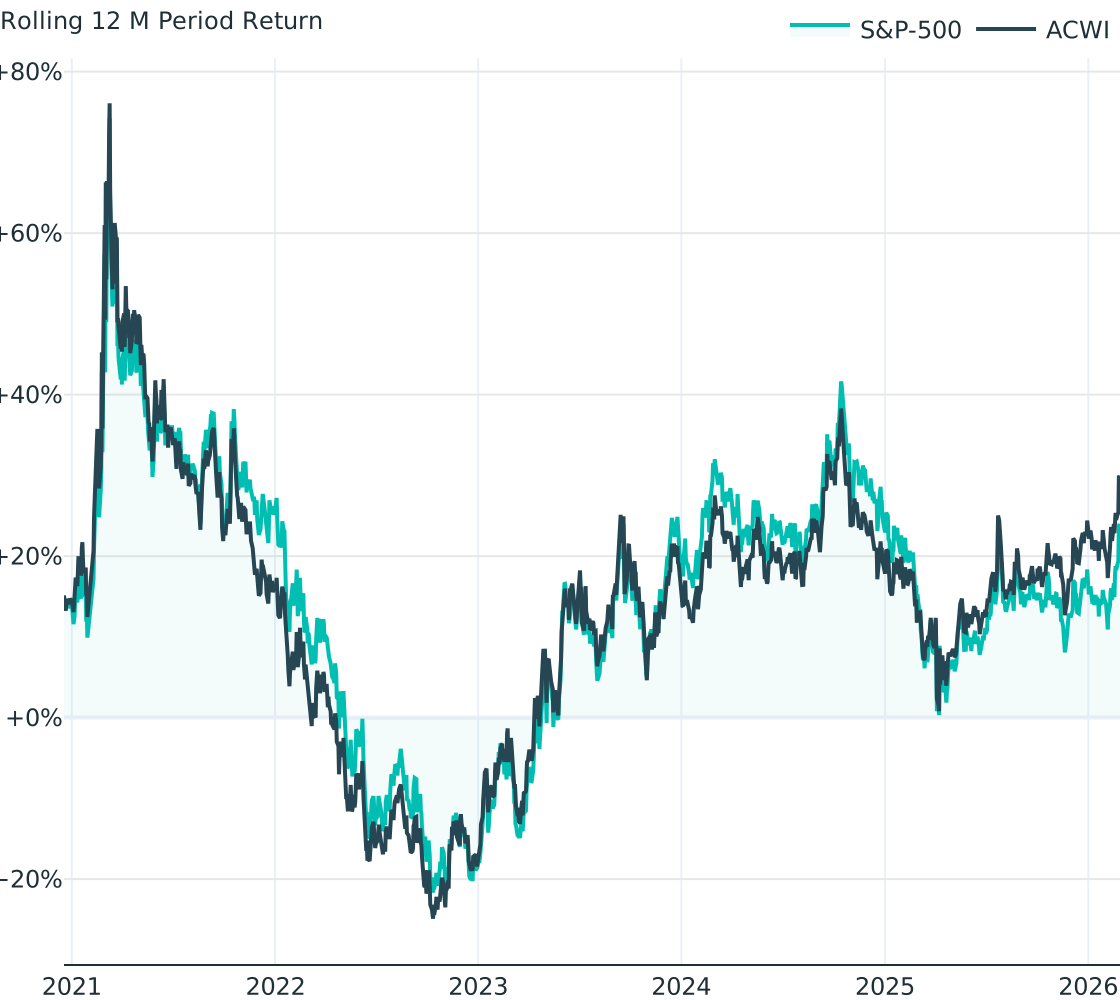
Rolling 12 M skewness: S&P-500 vs. ACWI
This view is useful for detecting regime changes in return behaviour. An asset that appears broadly neutral in its full-period skewness might reveal persistent negative skewness during certain market phases. A strategy that consistently shows positive rolling skewness—with frequent small negative periods and occasional large gains—has a structurally different risk profile from one that shows negative rolling skewness in the same environment.
Rolling skewness is available in the pfolio app.
Limitations
Skewness is estimated from a finite sample. As with all higher moments of the return distribution, the estimate is sensitive to the sample period chosen: a single extreme observation can materially change the skewness, particularly for short return histories. The cubic power in the formula amplifies this sensitivity—extreme values have an outsized effect on the result.
Skewness measures only asymmetry. It does not capture how extreme the tail events are relative to a normal distribution—that is the role of kurtosis. A complete picture of distributional risk requires both measures.
Skewness is also a linear measure of asymmetry; it captures the third moment but not more complex non-linear patterns in the distribution. For a comprehensive view of tail risk, metrics such as value at risk and expected shortfall provide complementary perspectives.
Skewness in pfolio
In pfolio, skewness is calculated from the return series derived from the price data. Whether those returns are computed from the close price or the adjusted close price can be configured via advanced settings—a distinction that matters for dividend-paying assets.
Skewness and rolling skewness are available in the pfolio app. For a full description of how pfolio calculates this and all other metrics, see the metrics we use.
Related metrics
Disclaimer

Get started now


