



Sharpe ratio explained: measuring risk-adjusted portfolio returns
A portfolio's return is easy to measure. What is harder—and more important—is knowing how much risk was taken to generate it. The Sharpe ratio is the standard answer to that question: it divides excess return by volatility, allowing portfolios with very different risk profiles to be compared on equal terms. Two portfolios can have identical returns but one may be taking twice the risk; the Sharpe ratio makes this visible immediately.
What the Sharpe ratio measures
The Sharpe ratio was introduced by William F. Sharpe (1966) in Mutual Fund Performance, Journal of Business, as a standardised way to measure investment performance adjusted for risk. Its central insight—that return cannot be assessed without accounting for the risk taken to achieve it—has made it the most widely used benchmark for comparing portfolios across asset classes and strategies.
The Sharpe ratio divides the excess return of an investment—its return above the risk-free rate—by its volatility. The risk-free rate serves as the baseline: it represents the return available with no risk. Any return above this baseline must be justified by the risk taken to achieve it. The ratio therefore measures how efficiently risk has been converted into return.
A higher ratio is better. It means the investment is generating more excess return per unit of volatility. A ratio below zero means the investment has returned less than the risk-free rate on average—the investor has taken risk without being compensated for it.
It is essential to compare Sharpe ratios computed with the same risk-free rate and over the same time period. A ratio computed with a 4% risk-free rate will look very different from one computed with a 0% rate, even for identical portfolios. When reading a Sharpe ratio from any source, always confirm the inputs.
The formula
S = (r̅ − rᵠ) / σ
Where:
- S = Sharpe ratio
- r̅ = annualised mean return
- rᵠ = risk-free rate
- σ = annualised standard deviation (volatility)
The numerator isolates the return that is attributable to risk-taking—the excess above what an investor could have earned without taking any risk. The denominator normalises this by the degree of volatility in the return series. Dividing one by the other gives a measure of how much excess return was generated per unit of volatility.
How to interpret the Sharpe ratio
There are no universal thresholds for Sharpe ratio interpretation, but some rough benchmarks are widely used. A ratio below 0.5 is generally considered poor for a diversified portfolio; 0.5–1.0 is acceptable; 1.0–1.5 is good; above 2.0 is exceptional and often warrants scrutiny of the methodology and period.
A worked example: a portfolio has an annualised mean return of 10%, a risk-free rate of 2%, and annualised volatility of 15%. The excess return is 8%, and the Sharpe ratio is 8/15 = 0.53. This is in the acceptable range, but a different portfolio with the same 10% return and 8% volatility would have a Sharpe ratio of 1.0—double the risk-adjusted performance for the same absolute return.
The Sharpe ratio is most useful when comparing portfolios within the same asset class or strategy category. Comparing a cryptocurrency portfolio to a bond portfolio using Sharpe ratios is less meaningful because the nature of risk and return in each category is fundamentally different.
Rolling Sharpe ratio
The scalar Sharpe ratio summarises risk-adjusted return across the full measurement period. Rolling Sharpe ratio computes the same metric over a sliding window, showing how risk-adjusted performance has varied through different market conditions.
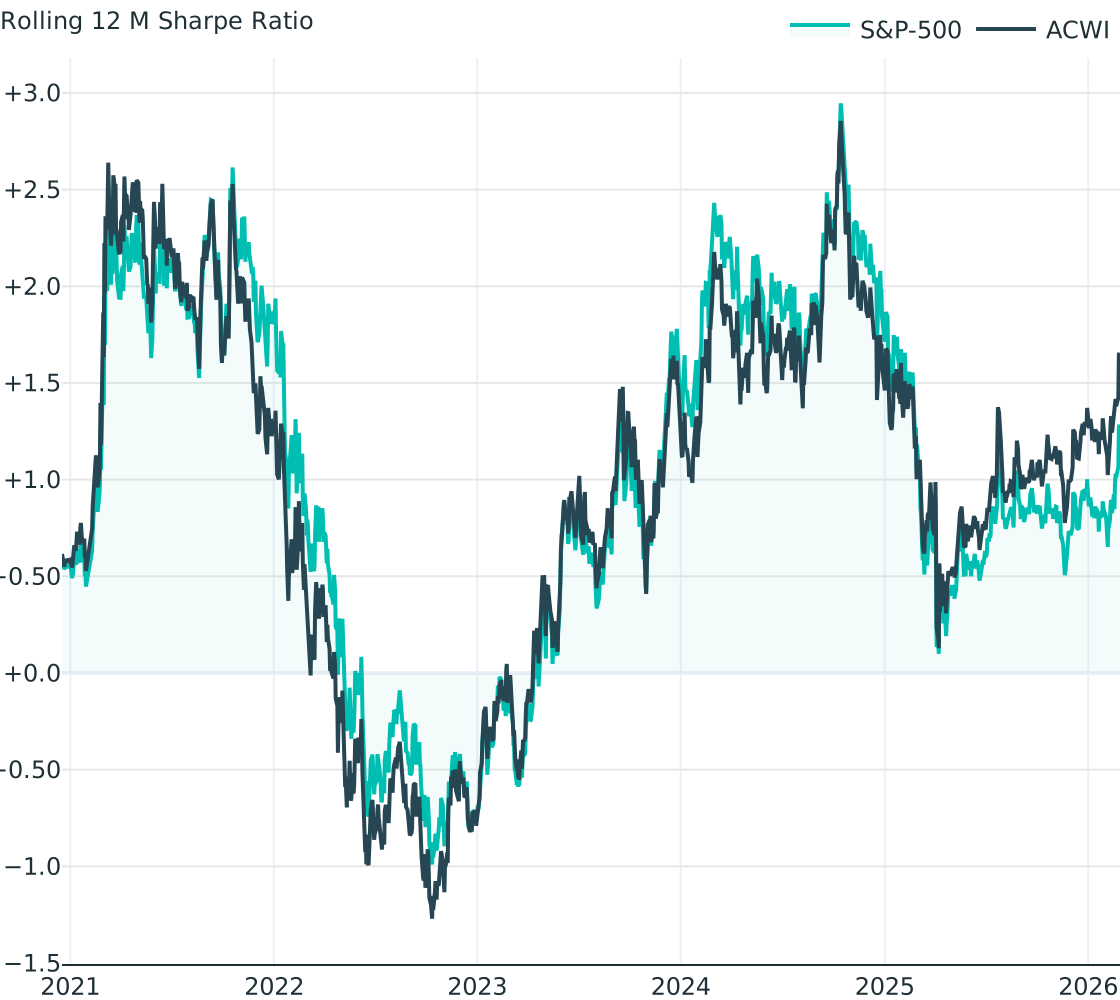
Rolling 12 M Sharpe ratio: S&P-500 vs. ACWI
This view reveals whether a strategy's risk-adjusted performance is consistent or concentrated in specific favourable periods. A strategy that shows a high full-period Sharpe ratio but highly variable rolling figures may be capturing a specific market regime. Consistent rolling Sharpe ratios across different environments provide stronger evidence of robustness.
Rolling Sharpe ratio is available in pfolio Insights and the pfolio app. The risk-free rate used in pfolio is configurable.
Limitations
The Sharpe ratio uses total volatility—including upside fluctuations—as its risk denominator. For portfolios with asymmetric return distributions, this penalises positive variability alongside negative variability. The Sortino ratio addresses this by using only downside volatility.
The Sharpe ratio assumes normally distributed returns and can be misleading for strategies with significant skewness or kurtosis. A strategy that generates small, consistent gains with occasional catastrophic losses may show a high Sharpe ratio despite carrying significant tail risk that the metric does not capture.
Like any backward-looking metric, the Sharpe ratio reflects past performance over a specific period. It is not a guarantee of future risk-adjusted returns. Results are sensitive to the start and end dates of the measurement window, and to the risk-free rate used.
Sharpe ratio in pfolio
In pfolio, the Sharpe ratio is calculated from the return series derived from the price data. Whether those returns are computed from the close price or the adjusted close price can be configured via advanced settings—a distinction that matters for dividend-paying assets. The risk-free rate is configurable in pfolio.
The Sharpe ratio and its rolling equivalent are available in pfolio Insights, as well as the pfolio app. For a full description of how pfolio calculates this and all other metrics, see the metrics we use.
Related metrics
Disclaimer

Get started now


