



Sortino ratio: a better measure of downside risk-adjusted return
The Sortino ratio is a risk-adjusted return measure that penalises only downside volatility, ignoring the upside fluctuations that investors generally welcome. It addresses a recognised limitation of the Sharpe ratio: the Sharpe ratio uses total volatility as its risk denominator, which penalises positive return variation alongside negative. The Sortino ratio isolates the downside, providing a more focused measure of how well a portfolio compensates investors for the risk of actual losses.
What the Sortino ratio measures
The Sortino ratio was developed by Frank Sortino and Lyle Price (1994) in Performance Measurement in a Downside Risk Framework, Journal of Investing, as a refinement of the Sharpe ratio designed specifically for portfolios with asymmetric return distributions. Its central improvement is to distinguish between harmful downside volatility and benign upside variability—only the former should penalise an investment's risk-adjusted score.
The Sortino ratio divides excess return—return above the risk-free rate—by downside volatility rather than total volatility. The numerator is identical to the Sharpe ratio; the denominator changes. Where the Sharpe ratio penalises all volatility, the Sortino ratio penalises only volatility below zero (or below the minimum acceptable return threshold), focusing the risk measure on the experience of loss rather than the experience of variability in general.
A higher Sortino ratio is better: it means the portfolio is generating more return per unit of downside risk. The ratio is particularly useful for evaluating strategies that produce asymmetric return distributions—strategies with large positive skews, for instance, would show a lower Sharpe ratio (penalised by upside volatility) but a higher Sortino ratio (only the downside counts). It also makes the Sortino ratio more appropriate for strategies that deliberately target loss limitation, such as pfolio's adaptive multi-asset portfolios.
The formula
Sortino = (r̄ − rf) / σd
Where:
- r̄ = annualised mean return
- rf = risk-free rate
- σd = annualised downside volatility
The formula is structurally identical to the Sharpe ratio, replacing only the denominator. Because downside volatility is always less than or equal to total volatility, the Sortino ratio will always be greater than or equal to the Sharpe ratio for a given portfolio—the same numerator divided by a smaller or equal denominator produces a larger or equal result. The gap between the two ratios reflects how much of the total volatility comes from upside fluctuations.
How to interpret the Sortino ratio
The Sortino ratio is most useful as a comparative tool. An absolute threshold for 'good' is difficult to state because the ratio depends heavily on the risk-free rate, the period measured, and the strategy type. As a rough reference, values above 1.0 are generally considered good for a diversified multi-asset portfolio over a full market cycle.
When comparing two portfolios, the one with the higher Sortino ratio is generating more return per unit of downside risk—all else being equal, it is the preferable choice from a loss-risk perspective. A portfolio with a Sortino ratio of 1.4 and a Sharpe ratio of 0.9 has significant positive skew: most of its volatility comes from good months, and its loss periods are relatively contained. This combination is broadly desirable.
The Sortino ratio is most informative when compared to the same portfolio's Sharpe ratio. A wide gap between the two suggests the portfolio's volatility is predominantly from positive returns; a narrow gap suggests losses and gains are roughly equally dispersed. The relationship between the two ratios says as much about return distribution as the numbers themselves.
Rolling Sortino ratio
The scalar Sortino ratio summarises downside risk-adjusted return over the full measurement period. Rolling Sortino ratio computes the same metric over a sliding window, showing how the ratio has evolved through different market regimes.
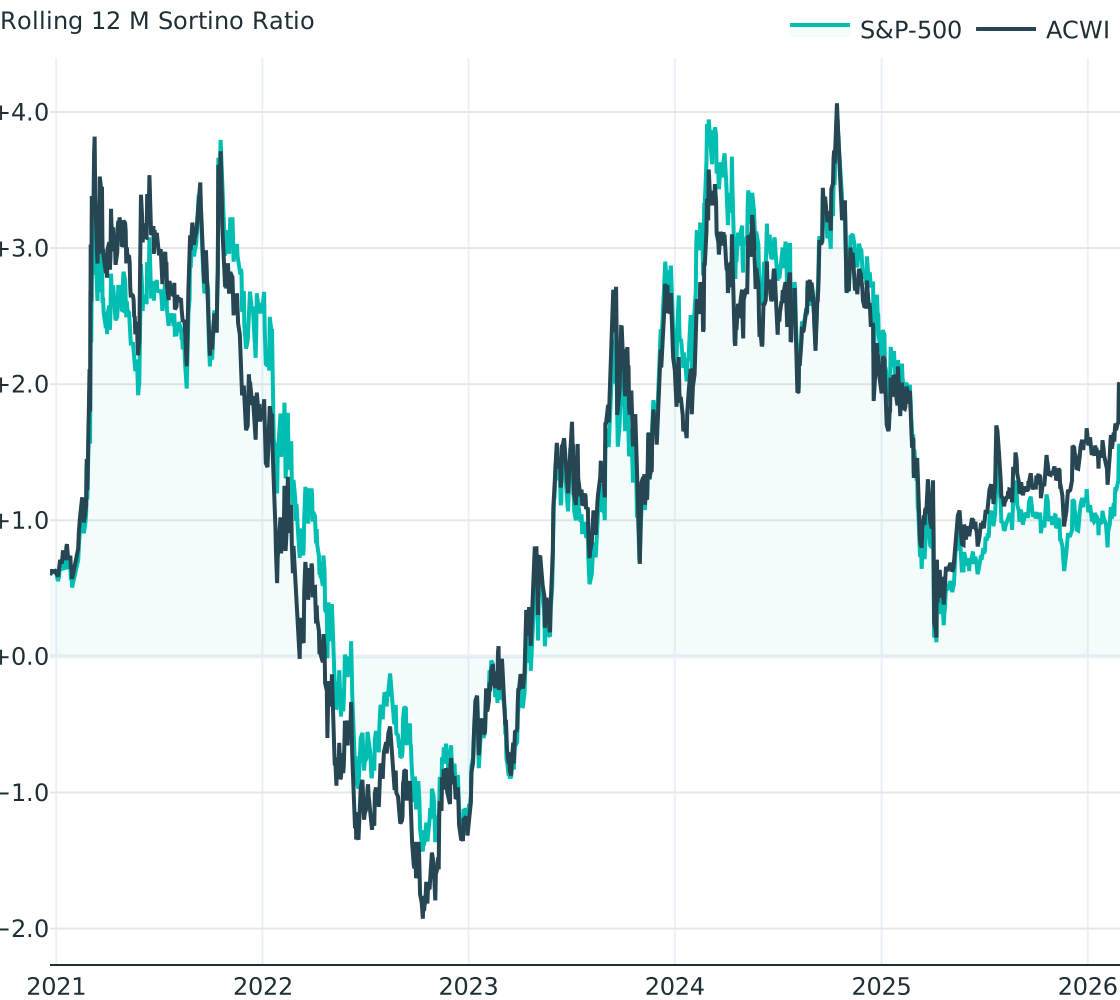
Rolling 12 M Sortino ratio: S&P-500 vs. ACWI
This view is particularly useful for assessing whether a strategy's loss-risk management is consistent. A strategy that maintains a high rolling Sortino ratio during equity drawdowns—when loss risk is highest—demonstrates that its downside protection is functioning. One that shows strong rolling Sortino ratios only during bull markets may be benefiting from a favourable environment rather than from robust risk management.
Rolling Sortino ratio is available in the pfolio app. The risk-free rate is configurable.
Limitations
Like the Sharpe ratio, the Sortino ratio is backward-looking and sensitive to the measurement period and risk-free rate used. A period that happens to include few loss periods will produce a high Sortino ratio that may not reflect the typical downside risk of the strategy over a full cycle.
The ratio also depends on the threshold used to define 'downside.' pfolio uses zero, meaning only negative return periods contribute to downside volatility. An alternative convention uses the risk-free rate or some minimum acceptable return as the threshold, which would produce different values. When comparing Sortino ratios across different sources, verify that the same threshold convention is used.
Finally, because downside volatility is estimated from fewer data points (only the negative return periods), the Sortino ratio can be noisier than the Sharpe ratio, particularly for strategies with few loss periods or short histories. A high Sortino ratio based on a small number of loss observations should be interpreted cautiously.
Sortino ratio in pfolio
In pfolio, the Sortino ratio is calculated from the return series derived from the price data. Whether those returns are computed from the close price or the adjusted close price can be configured via advanced settings—a distinction that matters for dividend-paying assets. pfolio uses zero as the downside threshold and uses a configurable risk-free rate.
The Sortino ratio and rolling Sortino ratio are available in the pfolio app. For a full description of how pfolio calculates this and all other metrics, see the metrics we use.
Related metrics
Disclaimer

Get started now


