



Volatility in investing: how to measure and manage portfolio risk
Volatility measures how much an investment’s returns fluctuate over time. A highly volatile asset swings sharply in both directions; a low-volatility asset moves more steadily. In portfolio management, volatility is the foundational measure of risk—it is the denominator of the Sharpe ratio, a key input in portfolio optimisation, and the most widely referenced single figure for how risky an investment is.
What volatility measures
The use of standard deviation of returns as the primary measure of investment risk was established by Harry Markowitz (1952) in Portfolio Selection, Journal of Finance—the paper that introduced mean-variance optimisation and made volatility the canonical input for quantitative risk measurement. The choice of standard deviation reflects a tractable mathematical property: it is the natural complement of mean return in the normal distribution framework, and it scales predictably with time horizon.
Volatility is the annualised standard deviation of periodic returns. It measures the typical magnitude of return fluctuations around the mean: how widely a portfolio’s actual returns are dispersed relative to its average return. A volatile investment has a wide dispersion—large positive returns are common, but so are large negative ones. A low-volatility investment has a narrow dispersion—returns are more predictable and closer to average.
The metric is expressed as a positive percentage. A volatility of 15% means that, approximately one year in three (one standard deviation), returns are expected to fall more than 15 percentage points below or above the mean. This assumes a normal distribution—a simplification that underestimates the frequency of extreme returns in practice, as explained in the Limitations section.
In pfolio, volatility is a ‘lower is better’ metric. This reflects the standard investment perspective: all else being equal, lower volatility means more stable returns and a more comfortable investor experience. Two investments with the same mean return are compared in the same way volatility is used in the Sharpe ratio—the lower-volatility option delivers the same return with less uncertainty.
The formula
σ = √(T/n × Σ(rᵢ − r̅)²)
Where:
- σ = annualised standard deviation (volatility)
- T = number of periods per year (252 for daily data, 12 for monthly)
- n = total number of observations in the return series
- rᵢ = return for period i
- r̅ = mean return for the series
The formula computes the average squared deviation of each return from the mean, then scales to an annual figure using the T/n multiplier, and takes the square root to express the result in the same unit as the returns (percentage). This annualised standard deviation is what pfolio reports as volatility.
How to interpret volatility
Volatility is a relative measure. There is no single threshold that makes volatility ‘high’ or ‘low’—it depends on the asset class, investment horizon, and investor risk tolerance.
As rough reference points: a broad global equity index typically shows annualised volatility in the range of 12–20% over a full market cycle. Individual equities are often considerably more volatile. Diversified multi-asset portfolios targeting lower risk typically aim for volatility in the 5–12% range. Cash or short-term bonds might show volatility below 2%. Cryptocurrencies can show volatility in excess of 60–80%.
What matters most is the relationship between volatility and return. Two portfolios with 15% volatility but very different mean returns present different value propositions. The Sharpe ratio formalises this by dividing excess return by volatility to produce a risk-adjusted measure.
Rolling volatility
The scalar volatility figure summarises the entire measurement period as a single number. Rolling volatility computes the same metric over a sliding window—for example, calculating the standard deviation of returns for every trailing 12-month period throughout a longer history. Each point on the resulting chart answers the question: what was the annualised volatility over the past 12 months ending on this date?
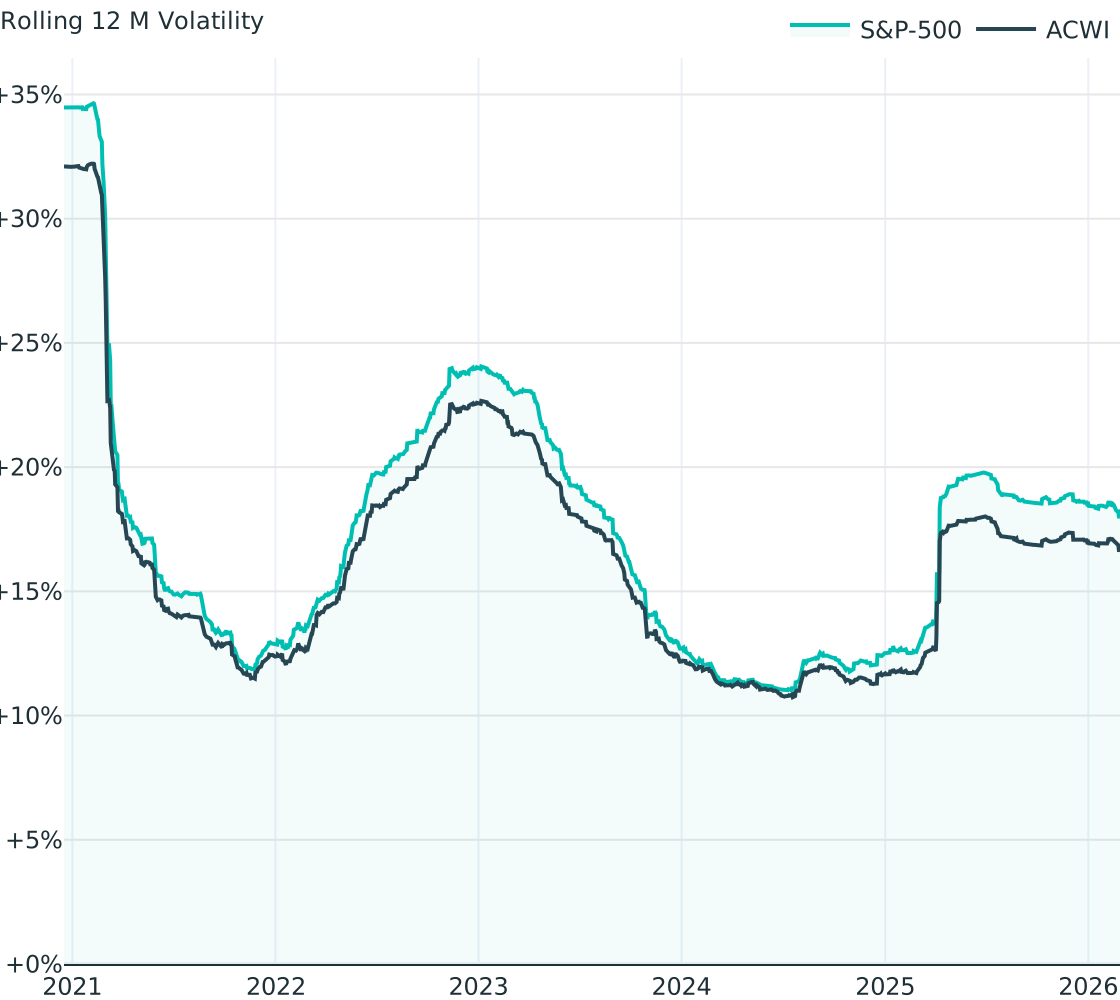
Rolling 12 M volatility: S&P-500 vs. ACWI
This view is valuable because volatility is not constant over time. Markets move through periods of calm (low volatility) and stress (high volatility). An investment that shows 12% volatility over a ten-year period might have had rolling 12-month volatility ranging from 6% during calm periods to 35% during crises. The scalar figure hides this variation; the rolling chart makes it visible. Rolling volatility is available in pfolio Insights and the pfolio app.
Limitations
Standard volatility treats upward and downward fluctuations equally. A portfolio that frequently delivers large positive returns would show high volatility—which is technically accurate but may not reflect the investor’s concern, which is typically with losses rather than gains. Downside volatility addresses this by measuring only the negative deviations.
Volatility also assumes returns are normally distributed. In practice, financial returns have fatter tails than the normal distribution predicts—extreme events occur more frequently than the model implies. This means that annualised standard deviation tends to underestimate the probability of severe losses. For investors primarily concerned with tail risk, metrics such as value at risk or expected shortfall may be more informative.
Finally, volatility measures the dispersion of past returns; it does not predict the magnitude of future returns. A period of low historical volatility does not guarantee low future volatility—markets can shift from calm to turbulent quickly and with little warning.
Volatility in pfolio
In pfolio, volatility is calculated from the return series derived from the price data. Whether those returns are computed from the close price or the adjusted close price can be configured via advanced settings—a distinction that matters for dividend-paying assets.
Volatility is displayed alongside rolling volatility in pfolio Insights, as well the pfolio app. For a full description of how pfolio calculates this and all other metrics, see the metrics we use.
Related metrics
Disclaimer

Get started now


